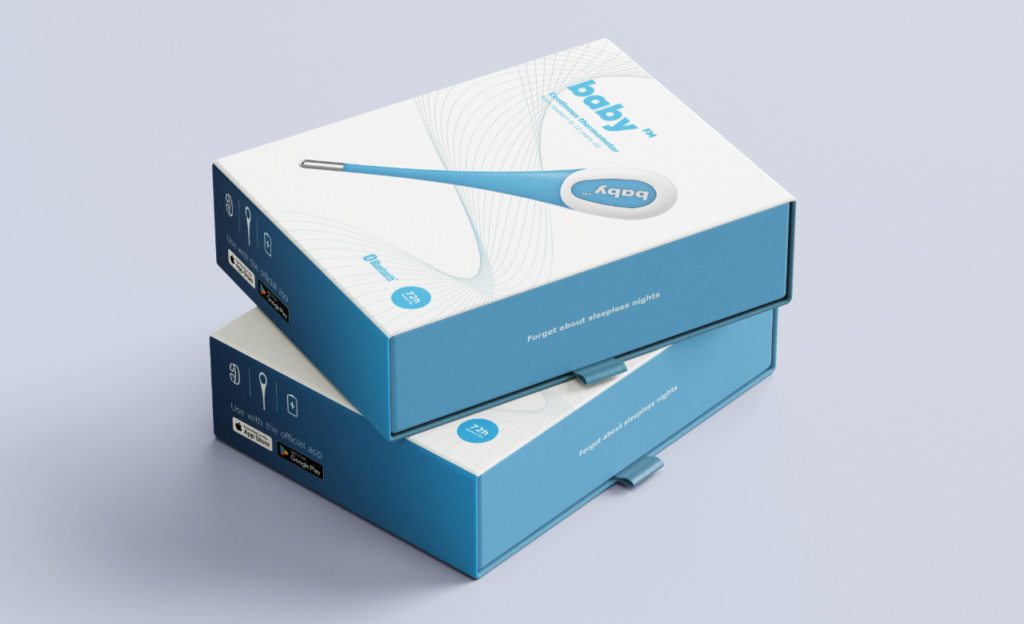
BabyFM was born from a simple but powerful idea: that continuous, reliable temperature monitoring can change outcomes for the most vulnerable patients: children and people with weakened immune systems. Today, that idea is backed by peer-reviewed science, clinical data, and a growing network of academic partners, including one of Slovakia’s leading technical universities.
A new peer-reviewed publication in Springer Nature’s SN Computer Science
We are proud to announce the publication of our latest research paper, “BabyFM Sensor Displacement Detection System: Performance Analysis with Clinical Dataset”, in SN Computer Science (Springer Nature). The paper presents the clinical and technical validation of BabyFM’s Sensor Displacement Detection (SDD) framework, the algorithm that ensures every temperature reading our device reports was actually taken with the sensor correctly in place.
The study analyzed 184,361 sensor readings collected over 500 cumulative hours from 22 patients at the University Clinical Centre of Serbia. The results speak for themselves:
- The SDD algorithm flagged only 1.14% of readings as displacement artifacts, remarkably close to the 1.4% rate predicted by our earlier theoretical model.
- 98.86% of all readings remained valid, meaning continuous monitoring is not compromised by artifact rejection.
- Device accuracy was independently confirmed in the BABYFM-010 clinical trial: across 658 paired measurements against a certified gallium reference thermometer, the mean difference was just −0.09 °C.
For parents and clinicians, this translates into something simple: fewer false alarms, trustworthy fever trends, and confidence in every number on the screen.
Why sensor displacement matters
A wearable thermometer is only as good as its contact with the skin. When a sensor slips (and with active children, it will), ordinary devices silently report misleading temperatures, triggering false hypothermia alarms or masking real fevers. BabyFM’s SDD framework solves this with an elegant, computationally lightweight rule: a reading is flagged when the temperature drops below 35.5 °C and the rate of change exceeds a non-physiological 1.2 °C per minute. Flagged intervals are excluded from fever-trend displays rather than silently averaged in, protecting the integrity of the clinical picture.
From the lab to certification
BabyFM is being developed as an EU MDR Class IIa medical device, with safety engineering aligned to ISO 14971 (risk management) and ISO 13485 (quality management), and software lifecycle processes compliant with IEC 62304 Class B. All data handling is fully GDPR-compliant. Independent EMC testing by accredited laboratories (Idvorsky Laboratories and SIQ Beograd) confirmed full compliance with EN 60601-1-2 and related standards. All tests passed.
What comes next
Our scientific roadmap is clear: dedicated prospective studies in the pediatric and immunocompromised populations BabyFM is designed for, multi-center validation, and the upcoming evaluation of our AI-based fever-prediction model, which builds directly on the clean, artifact-flagged data streams validated in this publication.
Together with our partners at FIIT STU and the wider Slovak research community, we are also opening the door to the next generation of engineers and researchers: student projects, joint supervision, and hands-on work with real medical-device technology, real clinical data, and real regulatory standards.
Science is not a marketing label for BabyFM. It is the foundation the product is built on.
Read the full open-access paper: Papić T., Dakić P., Lang J. “BabyFM Sensor Displacement Detection System: Performance Analysis with Clinical Dataset”, SN Computer Science, Springer Nature. DOI: 10.1007/s42979-026-05352-3